Pool Deck Pavers: The One Decision That Makes or Breaks Your Backyard
Your pool is the centerpiece. But the 800 to 1,200 square feet of surface surrounding it will determine whether your backyard feels like a resort or a liability. This is the decision most homeowners underestimate — and the one that matters most.
A pool installation in the Treasure Valley typically runs $60,000 to $120,000. The pool itself gets most of the attention during the planning phase — shape, depth, features, equipment. The deck surrounding it tends to be treated as an afterthought, something that gets decided late in the process based on what looks appealing in a catalog or what fits the remaining budget.
That’s a mistake. The pool deck is the surface your family walks on barefoot in July when air temperatures hit 100 degrees. It’s the surface your kids run across — wet — dozens of times a day. It’s the surface that has to handle thousands of gallons of splash-out, backwash, and rainwater without undermining the pool structure or creating standing water. And it’s the surface that has to survive Idaho’s freeze-thaw cycles every winter without cracking, heaving, or shifting.
The paver you choose, and the way your deck is built beneath it, determines whether all of that works — or whether you’re looking at repairs, safety concerns, and regret within the first few years.
Slip Resistance Is Not Optional — It’s the Entire Point
The single most important performance characteristic of a pool deck paver is slip resistance. This is a measurable property, not a subjective impression. Pavers are tested and rated using the Dynamic Coefficient of Friction (DCOF) standard, which measures how much traction a surface provides when wet. A DCOF rating of 0.42 or higher is the accepted threshold for wet areas. For pool decks, where barefoot traffic on saturated surfaces is constant, you want pavers that meaningfully exceed that threshold.
Tumbled pavers, textured finishes, and certain natural stone profiles all perform well in wet conditions. Smooth-finished pavers and polished surfaces — regardless of how attractive they look in a showroom — are a poor choice for pool surrounds. They may meet minimum ratings when new, but algae, mineral deposits, and surface wear reduce friction over time.
This is not an area where aesthetics should override performance. A beautiful pool deck that sends someone to the emergency room with a fractured wrist is not a successful project. Every paver manufacturer offers slip-rated options that look exceptional. Choosing among them is a design conversation. Choosing a paver that isn’t rated for wet conditions is a safety failure.
Heat Management: What 100-Degree Days Do to Your Deck
Boise averages 45 days per year above 90 degrees Fahrenheit, with peak summer surface temperatures regularly exceeding 140 degrees on dark-colored hardscape. If you’ve ever tried to walk barefoot across a dark concrete pool deck in August, you already understand the problem.
Paver color and material composition are the two primary factors in surface temperature. Lighter-colored pavers reflect more solar radiation and stay measurably cooler — the difference between a charcoal paver and a sandstone-toned paver of the same material can be 20 to 30 degrees at peak exposure. Some manufacturers now produce pavers with reflective pigment technology specifically designed for pool deck applications, and these products deliver meaningful real-world temperature reductions.
Material matters as well. Natural stone and concrete pavers absorb and release heat differently. Travertine, a popular pool deck material nationally, stays cooler than most concrete pavers but requires specific installation techniques and ongoing sealing to perform in Idaho’s climate. Porcelain pavers offer excellent heat performance and near-zero water absorption but come at a premium price point and require a modified installation approach.
The takeaway is straightforward: if you’re building a pool deck in the Treasure Valley, surface temperature should be part of the specification conversation from day one — not something you discover the first summer after installation.
Drainage Around Pools Is a Different Problem
Drainage design for a pool deck is more demanding than for a standard patio, and it’s the area where the most shortcuts are taken. The challenges are specific and cumulative.
First, the volume of water is significant. Splash-out from normal pool use, filter backwash, and deck washing all contribute water to the surrounding surface — on top of whatever precipitation the site receives. Idaho’s spring rainstorms can deliver an inch of rain in a few hours, and that water has to go somewhere that isn’t back into the pool, against the house foundation, or into a neighbor’s yard.
Second, the chemistry is different. Pool water contains chlorine, salt (in salt-chlorinated systems), and other chemicals that are hard on certain materials and joint systems over time. Drainage design needs to account for this — directing chemically treated water to appropriate discharge points and away from landscape beds where it can damage plants and soil.
Third, the grade tolerances are tighter. Pool decks must slope away from the pool coping — typically at a minimum of 1/4 inch per foot — while also draining away from any adjacent structures. On a large deck with a house on one side, a fence on another, and the pool in the center, achieving proper slope in all directions requires careful planning and precise execution.
Integrated channel drains, properly placed catch basins, and — on many Treasure Valley sites — subsurface drainage to manage the clay soils beneath the base are all standard components of a pool deck done correctly. A contractor who doesn’t raise drainage as a primary topic during your pool deck consultation is not thinking about the full scope of the work.
Idaho-Specific Considerations Most Contractors Miss
Building a pool deck in Boise is not the same as building one in Phoenix or Tampa. The climate imposes specific demands that out-of-state design guides don’t address and that less experienced contractors often overlook.
Freeze-thaw cycling. The Treasure Valley typically sees 100 to 130 freeze-thaw cycles per year — days where temperatures cross the 32-degree threshold in both directions. Water that penetrates the paver surface or joint system expands when it freezes, and that expansion is the primary mechanism of paver damage and displacement. Pavers with low water absorption rates — below 5% by ASTM standards — and properly applied polymeric sand that fully seals the joints are the front line of defense.
Expansive clay soils. Much of the Treasure Valley sits on clay-heavy soil that swells when wet and shrinks when dry. A pool deck built on an inadequate base over expansive clay will move — not dramatically, but enough to open joints, shift coping, and create trip hazards over time. The base specification for a pool deck on Treasure Valley clay should include a minimum of 8 inches of compacted crushed aggregate, installed in lifts, with geotextile fabric separating the aggregate from the native soil.
Seasonal pool closures. Unlike Sun Belt markets where pools run year-round, Treasure Valley pools are typically closed for four to five months. During that period, the deck surface is exposed to snow, ice, and freeze-thaw cycling without the moderating effect of heated pool water. Your pool deck needs to perform as a winter hardscape surface, not just a summer one.
Choosing the Right Paver for Your Pool Deck
The right pool deck paver balances five factors: slip resistance, heat management, water absorption, aesthetic appeal, and long-term durability in Idaho’s climate. No single product is perfect on every dimension, but several categories perform well across all of them.
Textured concrete pavers in lighter colorways offer the best combination of performance, durability, and value for most Treasure Valley pool decks. Products from Belgard, Unilock, and Pavestone all include lines specifically designed for pool surrounds, with slip ratings, color options, and freeze-thaw performance data available.
Porcelain pavers are gaining ground in the premium segment. Their near-zero water absorption makes them exceptionally freeze-thaw resistant, their surface stays cooler than most alternatives, and their slip ratings are excellent. Installation requires a modified approach — typically a mortar-set or pedestal system rather than a sand-set base — and the material cost is higher, but for homeowners prioritizing performance and willing to invest accordingly, porcelain is a strong choice.
Natural stone — particularly travertine and limestone — offers unmatched aesthetic warmth but requires more consideration in Idaho’s climate. Travertine’s natural porosity means it must be sealed regularly to maintain freeze-thaw performance, and certain finishes are better suited to wet conditions than others. When specified and installed correctly, natural stone pool decks are stunning and durable. When specified poorly, they deteriorate faster than concrete alternatives.
The decision starts with an honest conversation about priorities, budget, and how the space will be used. A contractor who leads that conversation with product knowledge and site-specific recommendations — rather than just showing you a color chart — is a contractor who understands pool deck work.
Ready to Get It Done Right?
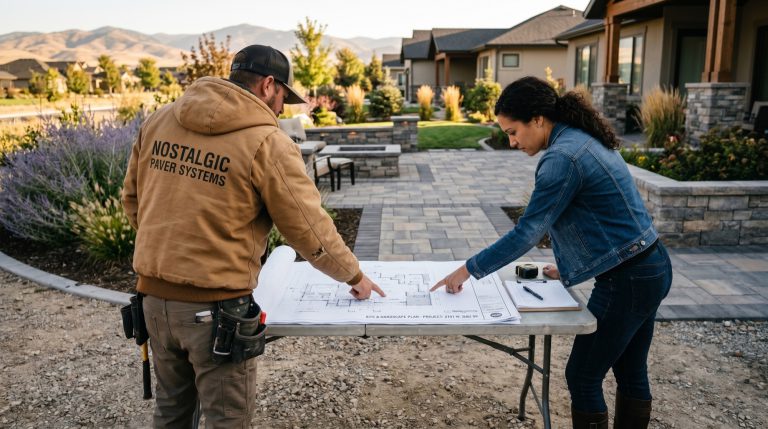
A pool deck is one of the highest-use surfaces on your property, and it needs to perform in ways that go well beyond appearance. At Nostalgic Paver Systems, we’ve been building pool decks in the Treasure Valley for over 20 years, and every project starts with a detailed site evaluation, a drainage plan, and a material recommendation based on how your specific site and pool configuration will perform — not just what looks good in a brochure.
If you’re planning a pool project or replacing an existing deck that isn’t performing, we’d like to talk about what the right solution looks like for your property.
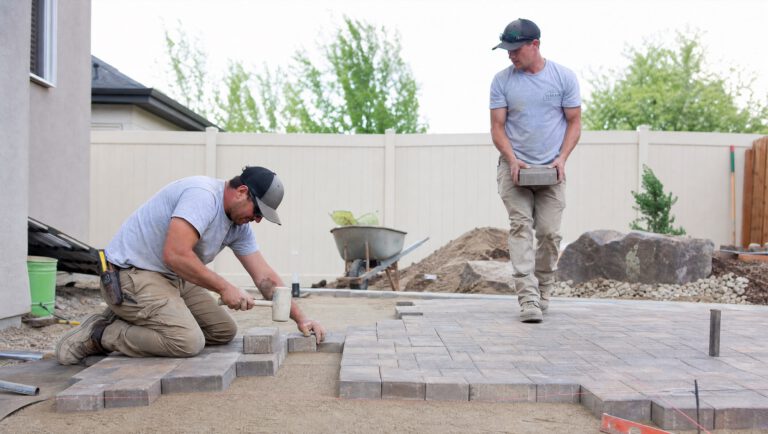
See how we approach pool deck installation in Boise — from base prep to final joint sand.
Book a Project Discovery Call today.
Prefer to talk it through now? Call (208) 609-9805 — no cost, no commitment, just a conversation.
Frequently Asked Questions
What is the best paver material for a pool deck in Idaho?
Textured concrete pavers in lighter colorways offer the strongest overall performance for most Treasure Valley pool decks — good slip resistance, manageable surface temperatures, low water absorption, and proven freeze-thaw durability. Porcelain pavers are an excellent premium alternative with superior water absorption and heat performance. The best choice for a specific project depends on site conditions, design goals, and budget.
How hot do pool deck pavers get in Boise summers?
Surface temperatures on pool deck pavers vary significantly by color and material. Dark-colored pavers can exceed 140 degrees Fahrenheit on peak summer days in the Treasure Valley. Light-colored pavers of the same material will typically run 20 to 30 degrees cooler. Pavers with reflective pigment technology can reduce surface temperatures further. Color selection is one of the most impactful decisions for barefoot comfort.
Do pool deck pavers need to be sealed?
It depends on the material. Natural stone pavers — particularly travertine and limestone — should be sealed to reduce water absorption and maintain freeze-thaw performance in Idaho’s climate. Most quality concrete pavers do not require sealing for performance purposes, though some homeowners choose to seal them for color enhancement or stain resistance. Porcelain pavers do not require sealing. Your contractor should specify the maintenance requirements for whatever material is selected.
How do you handle drainage around a pool deck?
Proper pool deck drainage requires the finished surface to slope away from the pool coping at a minimum of 1/4 inch per foot, with water directed to appropriate discharge points away from structures, landscape beds, and neighboring properties. Most pool decks benefit from integrated channel drains at key transition points. On Treasure Valley clay soils, subsurface drainage beneath the base is often necessary to prevent water from accumulating under the installation and causing movement during freeze-thaw cycles.
Can pavers be installed right up to the pool coping?
Yes, and this is the standard approach for a professional pool deck installation. Pavers are cut and fitted to the pool coping with appropriate joint spacing, creating a clean, integrated appearance. The joint between the coping and the pavers is typically filled with a flexible sealant rather than polymeric sand, allowing for the minor movement that occurs between the pool structure and the surrounding deck without cracking or separation.
How long does a pool deck paver installation take?
A typical residential pool deck installation in the Treasure Valley takes one to three weeks depending on the size of the deck, the complexity of the drainage work, and the material selected. Projects requiring significant excavation, subsurface drainage, or complex patterns will run toward the longer end. A detailed project timeline should be part of any professional proposal.
Nostalgic Paver Systems · Boise, Idaho · Serving the Greater Treasure Valley · nostalgicpavers.com
Nostalgic Paver Systems
Planning a project of your own?
Let’s talk through your space, your timeline, and what it would take to build it right the first time.
Book a Project Discovery Call