The Real Cost of Hiring the Wrong Hardscape Contractor
It starts with a low bid that seems too good to pass up. It ends with a failing installation, a contractor who has stopped returning calls, and a repair bill that exceeds what the right contractor would have charged the first time.
The real cost of hiring the wrong hardscape contractor is not just financial, though the financial cost is significant. It’s the wasted months of a project season. The summer you didn’t use your backyard because it was torn up by a crew that didn’t finish. The ongoing aggravation of watching a $60,000 installation slowly deteriorate while the contractor who built it stonewalls every attempt to get them back out. The second contractor — the right one this time — who tells you that fixing the mess properly means tearing out most of what was done and starting over.
This scenario plays out regularly in the Treasure Valley. We know because we get those calls. Homeowners who found us after a first installation went wrong, asking whether what they’re looking at is fixable, how much it would cost, and whether it’s really as bad as they think it is. Sometimes it is. Sometimes it’s worse.
This piece is for homeowners who are either evaluating contractors right now and want to understand the risks clearly, or who have already had a bad experience and want to understand their options. It’s also an honest accounting of what goes wrong, why it goes wrong, and what it actually costs when it does.
How It Usually Happens: A Realistic Scenario
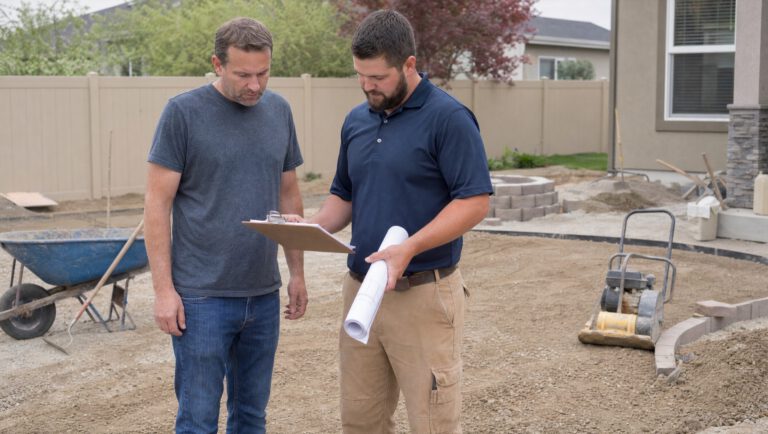
The homeowner receives three bids for a paver patio and driveway project. Two come in between $70,000 and $80,000. The third is $42,000. The lower contractor seems professional in the initial meeting — good communication, a nice truck, a folder of photos. He talks confidently about the work and says he can start in two weeks.
The homeowner takes the lower bid. The logic is understandable: $30,000 is a meaningful difference, the contractor seems capable, and maybe the other two are just overcharging.
Early in the project:
Work begins and initially looks like progress. Excavation happens. Material arrives. Pavers go down. The homeowner is pleased — it’s moving faster than expected. The contractor mentions he has another job starting and needs to finish up quickly. The crew works long days for a week and completes the installation.
Three months later:
The homeowner notices that a section near the garage has started to drop slightly. There are small gaps opening between pavers along one edge of the patio. After a heavy rain, water pools in the center of the driveway rather than draining to the sides. The contractor is called. He comes out, looks at it, says it just needs to settle and will be fine. He doesn’t do anything.
After the first winter:
The dropped section near the garage has worsened noticeably. Two pavers along the patio edge have lifted and are now a trip hazard. The water pooling on the driveway has left a stain, and there’s evidence that it’s been seeping under the surface — the adjacent section shows efflorescence staining and there’s a subtle but growing unevenness across about a quarter of the driveway. The homeowner calls the contractor repeatedly. Calls go to voicemail. One text message reply says he’ll come by next week. He doesn’t.
After the second winter:
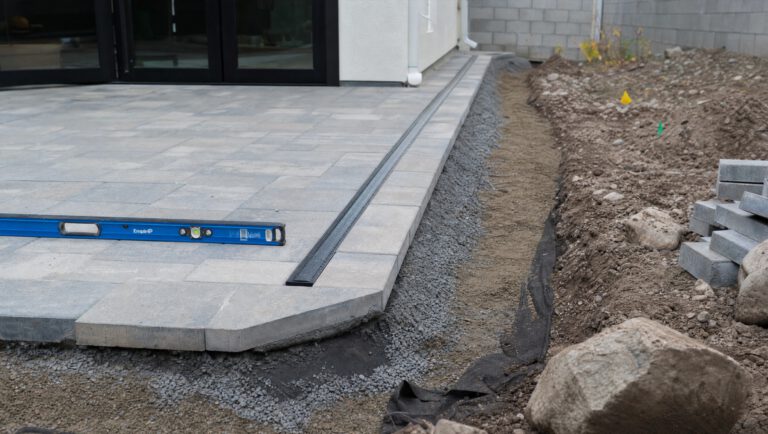
The installation has deteriorated to the point where the homeowner hires a second contractor to assess it. The assessment: the base was too shallow — approximately 3 inches rather than the 6 to 8 required — and was not properly compacted. There is no drainage slope on the driveway; it is essentially flat, which is why water pools and seeps. The edge restraints on the patio were inadequately staked and have failed, which is why the perimeter pavers are migrating outward. Fixing it correctly means removing the pavers, correcting the base, installing drainage, and reinstalling. Estimated cost: $58,000.
The homeowner has now spent $42,000 on an installation that needs to be torn out, plus $58,000 to do it correctly. Total expenditure: $100,000 for a job that would have cost $75,000 the first time with the right contractor. The contractor who did the original work is no longer reachable and has dissolved his business entity.
The cheapest bid rarely produces the cheapest outcome. The gap between the low number and the right number often reappears — on a second invoice, after the damage is done.
What Does a Failed Hardscape Installation Actually Cost?
The financial cost of a failed installation has several components, and homeowners rarely account for all of them at the outset:
The Original Contract Price
The money paid to the original contractor is typically unrecoverable once the work is done and the contractor is unresponsive. Pursuing it through civil litigation is possible but expensive, slow, and often unsuccessful when the contractor has dissolved or is judgment-proof. Most homeowners write it off and focus on what it will cost to fix the situation rather than recover the original payment.
The Demolition and Haul-Away Cost
Removing a failed installation is not free. Pavers need to be lifted, base material excavated, and debris hauled away. On a project of meaningful scale, demolition and removal alone can run $5,000 to $15,000 or more — work that adds nothing to the finished product but is necessary before the right installation can be built. This cost doesn’t exist when the first contractor does the job correctly.
The Correct Installation Cost
After demolition, the homeowner essentially pays for the installation twice — once to the original contractor for the failed work, and again to the second contractor to do it correctly. The second installation often costs more than the original quote from the quality contractors, because material and labor costs may have increased, and because the second contractor has to deal with site conditions affected by the failed first attempt.
Secondary Damage
A failed hardscape installation doesn’t always fail in isolation. Poor drainage can direct water toward a foundation, causing moisture infiltration, efflorescence, or in serious cases structural damage that has nothing to do with the patio itself. A retaining wall that fails can damage landscaping, irrigation systems, or adjacent structures. A driveway that settles unevenly can damage vehicles with low ground clearance. Secondary damage from a failed installation adds costs that are entirely separate from the hardscape repair itself.
The Time Cost
Time doesn’t appear on an invoice, but it’s real. The months spent trying to get the original contractor to respond. The project season lost while the issue is assessed, quoted, and rescheduled. The second contractor’s lead time, which — if the homeowner is trying to fix a spring problem before summer — may push the correction into fall. A homeowner who started a project in April with the expectation of using the space by June may not have a functional outdoor space until the following summer. That’s a year of use, plus the stress of the entire experience.
Why Do Hardscape Projects Go Wrong?
Understanding why installations fail is useful for preventing it. The root causes are consistent across most of the failure scenarios we encounter:
Inadequate Base Preparation
The single most common cause of paver system failure is a base that was too shallow, improperly compacted, or built with the wrong aggregate. This shortcut saves significant time and material cost during installation and is completely invisible at completion. In Idaho’s freeze-thaw climate and clay-heavy soils, it typically reveals itself within one to three winters.
No Drainage Design
Drainage design requires site assessment, planning, and sometimes additional materials — all of which cost time and money. Contractors who skip it produce installations that look complete but are actively working against the homeowner every time it rains. Surface pooling, base saturation, and freeze-thaw damage are the predictable consequences. In the Treasure Valley’s clay soils, poor drainage is almost always a contributing factor in failing installations.
Underqualified or Unsupervised Labor
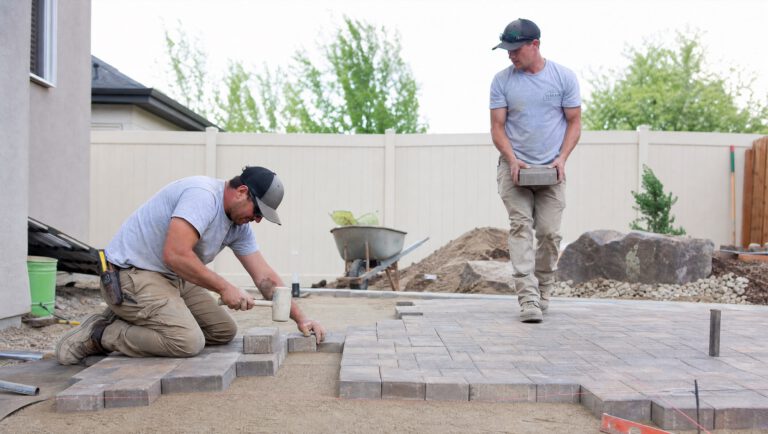
Paver installation done correctly is skilled trade work. Contractors who win jobs on low bids often staff those jobs with inexperienced crews who don’t have the knowledge to execute the technical elements correctly — screeding bedding sand to proper depth and levelness, establishing accurate drainage slope, cutting pavers precisely, applying and activating polymeric sand correctly. The contractor may know what good work looks like; the crew executing it may not. The homeowner never knows the difference until the results arrive.
No Accountability Structure
Contractors who operate without proper insurance, without a genuine workmanship warranty, or without an established business reputation have limited accountability for what happens after the project is complete. When something goes wrong — and with a poorly built installation in Idaho’s climate, something will go wrong — the homeowner has little recourse. A contractor with 20 years in the market, an active insurance policy, and a reputation to protect has every incentive to stand behind the work. A contractor who can dissolve an LLC and operate under a new name next season has none.
The Race to Finish
Low-bid contractors often win multiple jobs simultaneously and pressure crews to complete projects quickly so they can move to the next one. Speed and quality are in fundamental tension on a paver installation — compaction lifts can’t be rushed, screeding can’t be rushed, polymeric sand activation can’t be rushed. A crew under pressure to finish by Friday will find ways to compress these steps. The homeowner won’t know it happened. The installation will eventually show it did.
A contractor who disappears when problems arise was always going to disappear. The quality of their character shows up in the quality of their base preparation.
What Are the Warning Signs Before You Hire?
Most of the warning signs are visible during the evaluation process, before any work begins. Here’s what to watch for:
- A bid significantly lower than the others — not modestly lower, but dramatically so. A 40% or 50% gap between bids for comparable scopes is almost always a specification difference, not a pricing difference.
- Quoting from photos or satellite imagery without visiting the site. Drainage cannot be designed from a satellite image. A contractor who hasn’t walked the property hasn’t designed the project.
- Vague or evasive answers to technical questions about base depth, compaction method, drainage approach, or edge restraint systems. A contractor who knows their work can answer these precisely.
- Pressure to sign quickly — urgency tactics like “I can only hold this price for 48 hours” or “I have another customer waiting for this slot” are designed to prevent the evaluation process from completing.
- No certificate of insurance, or resistance to providing one. This is a non-negotiable. An uninsured contractor is an unprotected homeowner.
- Warranty language full of exclusions, or a warranty that’s vague about what the contractor will actually do if a problem arises.
- Limited or unverifiable portfolio — photos without accompanying references, or references who can’t be contacted directly.
- A contractor who has been operating in the market for a short time, or whose business entity is newly formed. Not every new contractor is bad, but longevity in the local market is a meaningful signal.
What Are My Options If the Installation Has Already Failed?
If you’re reading this because an installation has already gone wrong, your options depend on where things stand:
If the Contractor Is Still Reachable and the Warranty Is Active
Document everything — photographs of the problem areas with dates, written communication records, and your original contract. Send a formal written demand (email with read receipt or certified mail) specifying the problem, citing the warranty terms, and setting a reasonable deadline for the contractor to respond and schedule a repair. If they fail to respond, you have documented evidence for a small claims or civil court filing, or a complaint to the Idaho Contractors Board.
If the Contractor Is Unresponsive or Has Dissolved
Your practical recourse is limited but not zero. If the contractor carried general liability insurance, a claim against that policy may be possible for property damage resulting from defective work. If you paid by credit card, a chargeback for services not rendered as contracted is worth exploring with your card issuer, though timing limitations apply. Small claims court is available for smaller amounts; civil litigation for larger ones. A construction attorney can advise on the specific circumstances.
Getting an Honest Assessment of the Damage
Before deciding on next steps, get an honest assessment of what’s actually wrong and what it will take to fix it correctly. Not every failed installation requires a complete teardown — some problems are isolated and can be corrected without disturbing the rest of the surface. Understanding the actual scope of the repair, from a contractor who will give you a straight answer rather than a proposal designed to maximize the work, is the foundation for any rational decision about how to proceed.
Done Right the First Time. Every Time.
At Nostalgic Paver Systems, we’ve been doing this work in the Treasure Valley for over 20 years. We carry full general liability and workers’ compensation insurance. We build to the base depth and drainage specifications the application requires — not the minimum that makes a project look finished on day one. And we back every installation with a workmanship warranty we intend to honor, because our reputation in this market is built one project at a time and we can’t afford to build it any other way.
If you’re evaluating contractors for a new project, we’d welcome the chance to show you what a straight-answer conversation with a contractor looks like. If you’ve had a bad experience and want an honest assessment of what you’re dealing with, we can help with that too.
Here is what to expect instead from a Boise hardscape contractor who does it properly.
Book a Project Discovery Call today.
Prefer to talk it through now? Call (208) 609-9805 — no cost, no commitment, just a conversation.
Frequently Asked Questions
What can I do if my hardscape contractor did a bad job?
Start by documenting the problems thoroughly with dated photographs and written records of your communication attempts. Review your contract for warranty terms and send a formal written demand citing those terms. If the contractor is unresponsive, options include filing a complaint with the Idaho Contractors Board, pursuing a claim against their general liability insurance if the work caused property damage, and civil litigation for breach of contract. An attorney specializing in construction disputes can advise on the best path given your specific situation and the amount involved.
Can I get my money back from a bad contractor?
Recovering money from a contractor who has delivered substandard work is difficult, particularly if they are unresponsive or have dissolved their business entity. The most accessible options are credit card chargebacks (if applicable and within the allowable timeframe), small claims court for smaller amounts, and civil litigation for larger ones. The practical reality is that many homeowners in this situation focus on the cost of fixing the problem correctly rather than pursuing the original contractor — especially if that contractor is judgment-proof.
How do I know if my paver installation was done correctly?
A correctly installed paver system should be level and even across the entire surface, drain water away from structures promptly after rain, have no shifting or sinking sections after the first winter, have firmly set pavers with no rocking or movement underfoot, and have stable perimeter edges with no outward migration. Visible warning signs of installation problems include surface pooling after rain, efflorescence staining, shifting or lifted pavers — particularly along edges or near the structure — and gaps opening between pavers along the perimeter.
Is it worth fixing a bad paver installation or should I start over?
The answer depends on the nature and extent of the failure. Isolated issues — a small section with base problems, a perimeter edge that has migrated — can often be corrected without disturbing the entire installation. Widespread base failure, systemic drainage problems, or extensive paver shifting typically require a more comprehensive reset to fix correctly rather than just mask the symptoms. An honest assessment from a qualified contractor who isn’t trying to maximize the scope of the repair is the right starting point for this decision.
What is the most common complaint about hardscape contractors?
By a wide margin, the most common complaints about hardscape contractors involve poor communication during the project and failure to stand behind the work after completion. Homeowners frequently describe contractors who were responsive during the sales process and disappeared after receiving payment, failed to address problems identified during or after construction, and either ignored warranty claims or provided inadequate repairs. These patterns are predictable from the evaluation process — contractors who communicate poorly before the contract tend to communicate poorly afterward.
How do I report a bad contractor in Idaho?
In Idaho, contractor complaints can be filed with the Idaho Contractors Board, which oversees licensing and can investigate complaints about licensed contractors. The Better Business Bureau and Google Reviews are also channels for documenting your experience, which serves both as a record and a warning to other homeowners. If the contractor carried insurance and the work caused property damage, a claim can be filed directly with their insurer. For significant financial losses, consultation with a construction attorney is advisable before choosing a path.
Nostalgic Paver Systems · Boise, Idaho · Serving the Greater Treasure Valley · nostalgicpavers.com
Nostalgic Paver Systems
Planning a project of your own?
Let’s talk through your space, your timeline, and what it would take to build it right the first time.
Book a Project Discovery Call