The $0 Upgrade That Protects a $100,000 Outdoor Investment: Proper Drainage
Drainage doesn’t cost extra when it’s designed in from the start. It costs a fortune when it’s retrofitted after things go wrong — or ignored entirely.
Proper drainage is the single most important factor in determining how long a hardscape installation will last. It costs nothing extra when it’s incorporated into the design from the beginning. When it’s overlooked — or when a contractor simply doesn’t think about it — homeowners end up with pooling water, heaving pavers, structural damage to their home’s foundation, and repair bills that can run into the tens of thousands of dollars.
In the Treasure Valley, where clay soils hold water and freeze-thaw cycles punish any moisture that gets trapped beneath the surface, drainage isn’t a nice-to-have. It’s the foundation of a hardscape investment that actually holds its value.
This piece explains how drainage works in a paver system, what happens when it fails, and what homeowners investing in premium outdoor spaces should expect from a contractor who takes it seriously.
Why Is Drainage So Important for Paver Installations?
Water is the primary enemy of any hardscape system. It doesn’t need a crack to cause damage — it just needs a place to go. When water can’t drain away from a paver surface efficiently, it saturates the base material beneath. Once in the base, several things start happening, none of them good.
In winter, that trapped moisture freezes and expands, physically lifting pavers out of position. When it thaws, the pavers settle back — but not always evenly. Over multiple freeze-thaw cycles, this process creates the uneven, shifting surfaces that characterize a failing paver installation. In the Boise area, which experiences roughly 100 freeze-thaw events per year, this cycle repeats relentlessly on any system that hasn’t been properly waterproofed and drained.
In summer, saturated clay soils become soft and unstable, allowing heavy loads — a parked car, a crowded patio — to compress the base unevenly. As the soil dries and shrinks, it leaves voids beneath the surface that pavers eventually sink into.
Beyond the hardscape itself, poor drainage around outdoor living spaces can direct water toward a home’s foundation — one of the most expensive repair scenarios a homeowner can face. A patio that pitches slightly toward the house rather than away from it is actively working against the building it surrounds.
What Does Proper Drainage Actually Involve?
Drainage in a paver system isn’t a single feature — it’s a layered approach that begins in the design phase and is built into every step of the installation. Here’s what it encompasses:
Surface Slope and Grade
Every hardscape surface should be graded to direct water away from structures and toward appropriate drainage points. The industry standard for paver surfaces is a minimum slope of 1% — that’s about 1/8 inch of drop per foot of run. It’s subtle enough to be invisible to the eye but meaningful enough to move water efficiently. On many residential projects in the Treasure Valley, we slope toward yard areas, planter beds, or dedicated drainage channels depending on the site layout.
Permeable Base Design
The crushed aggregate base beneath the pavers isn’t just a structural platform — it’s a drainage layer. When specified correctly, it allows water that penetrates the paver joints to pass through and disperse into the native soil below, rather than pooling at the surface. The base material needs to be angular, well-graded aggregate — not pea gravel, not sand, and certainly not unscreened fill — to maintain both structural integrity and drainage performance.
Subsurface Drainage Infrastructure
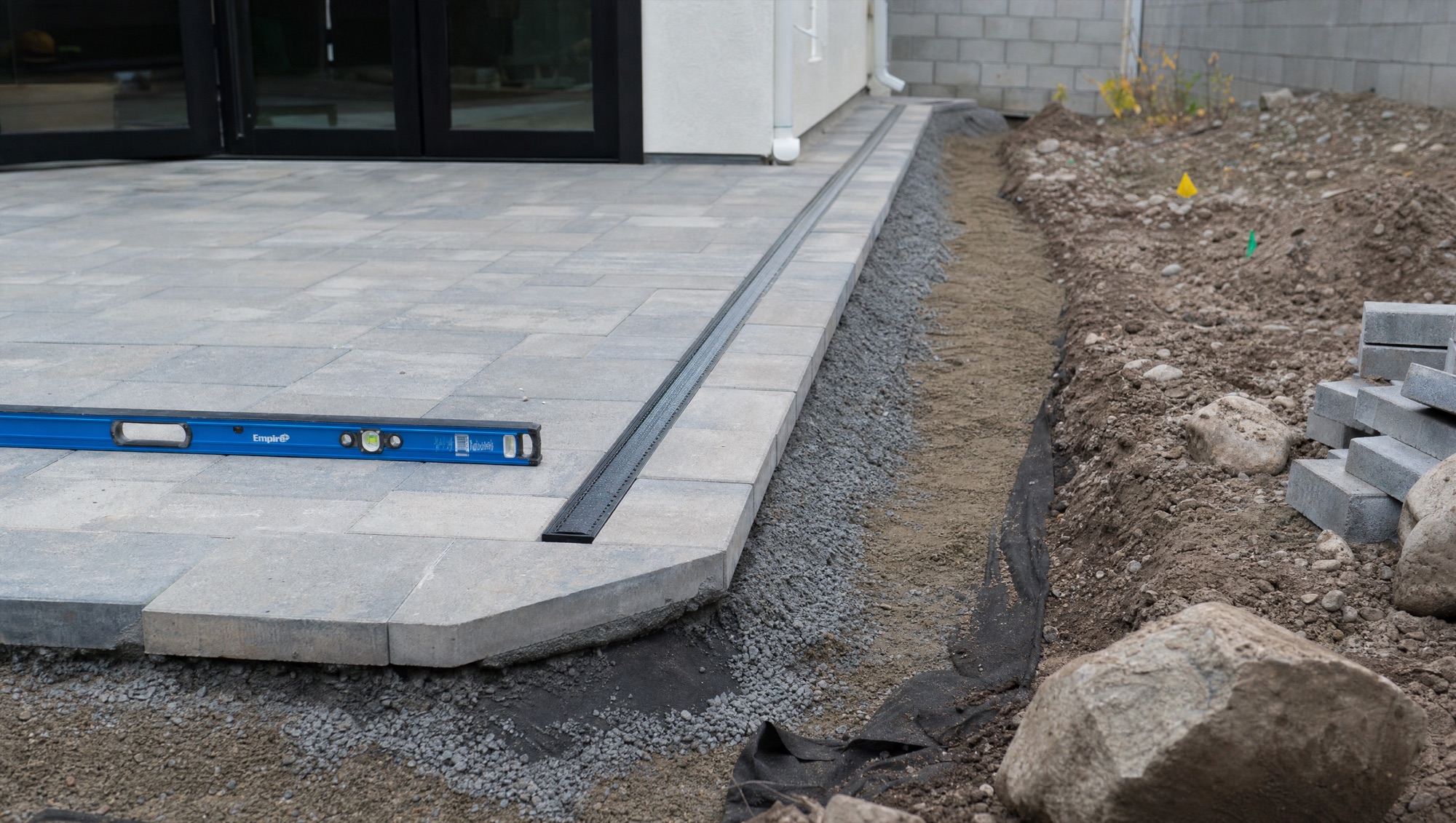
On sites with heavy clay soils, high water tables, or areas that receive concentrated water flow — downspout discharge zones, low spots in the yard, or spaces at the base of slopes — surface grading alone isn’t sufficient. These sites require subsurface drainage: perforated drain pipe, French drains, or channel drains integrated into the hardscape design to actively collect and redirect water. This is not an expensive add-on when planned from the start. It becomes expensive when it’s ignored and you’re cutting up a finished patio two years later to install what should have been there from day one.
Downspout and Roof Runoff Management
One of the most overlooked drainage challenges on residential hardscape projects is the roof. A standard home can shed hundreds of gallons of water per hour during a heavy rain event, and downspouts discharge all of that water at specific points around the foundation. When a new patio or driveway is installed without accounting for this, the hardscape often ends up collecting and concentrating that runoff rather than dispersing it. Good drainage design includes routing downspout discharge away from and under or around the hardscape, not into it.
Permeable Paver Options
For certain applications, permeable paver systems offer a drainage solution built into the surface itself. These systems use wider joints filled with clean stone aggregate, allowing water to pass directly through the paver field and into a specifically designed permeable base. They’re particularly well-suited to driveways, parking areas, and spaces where surface runoff is a consistent challenge. Permeable systems also offer environmental benefits — reducing stormwater runoff and supporting groundwater recharge — that are increasingly valued by Treasure Valley homeowners and required in some commercial applications.
What Are the Signs of a Drainage Problem in an Existing Paver System?
If you have an existing paver installation and are seeing any of the following, drainage failure is likely either the cause or a contributing factor:
- Standing water on the surface after rain, or water that takes more than a few minutes to drain
- Pavers that have shifted, lifted, or sunk — particularly after winter or a heavy rain event
- White, chalky staining on the paver surface (efflorescence) — caused by mineral-laden water repeatedly moving through the base and evaporating at the surface
- Erosion or washout in the joint sand — water moving across or through the surface is carrying material with it
- Soft or spongy areas when walking on the paved surface
- Water pooling against the house or visible moisture along the foundation
- Cracks or settling in concrete elements adjacent to the pavers
None of these problems resolve on their own. In most cases, they worsen with each successive wet season. Addressing the drainage issue early — before base failure becomes widespread — is almost always significantly less expensive than waiting.
How Do I Know If a Contractor Is Taking Drainage Seriously?
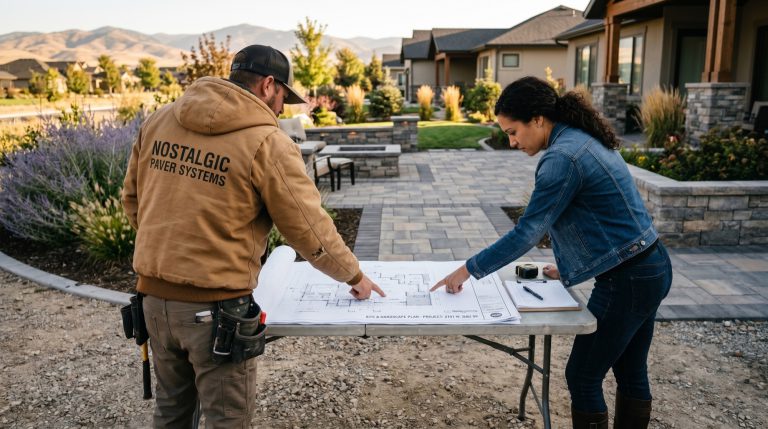
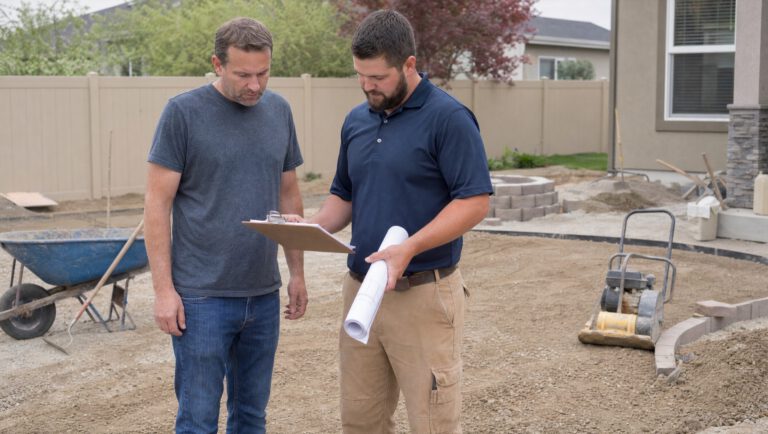
A contractor who understands drainage will talk about it before you ask. They’ll walk the site, identify where water currently flows, ask about downspout locations, and discuss how the finished installation will manage both surface runoff and subsurface moisture.
Specific things to look for in a contractor’s approach:
- They visit the site before quoting — you cannot design drainage from a satellite photo
- Their proposal specifies the slope gradient for the finished surface
- They ask about your downspout locations and existing drainage patterns
- They specify the type and depth of base aggregate, not just the pavers themselves
- On sites with drainage challenges, they propose specific solutions rather than generic assurances
A contractor who doesn’t raise drainage as a topic — or who dismisses it as not a concern on your site without actually assessing it — is a contractor who’s planning to let you discover the problem on your own, a couple of winters from now.
Let’s Talk About Your Site
Every property in the Treasure Valley is different. Soil conditions, slope, irrigation patterns, and roof geometry all factor into how drainage needs to be designed for your specific project. At Nostalgic Paver Systems, a proper site assessment — including drainage evaluation — is part of every project we take on. We’ve been doing this for over 20 years, and we’ve seen what happens when drainage is treated as an afterthought.
If you’re planning a patio, pool deck, driveway, or retaining wall — or if you’re dealing with an existing drainage problem on a hardscape installation — we’d be glad to walk your property and talk through your options.
Drainage is designed into every one of our hardscape services from the first site visit.
Book a Project Discovery Call today.
Prefer to talk it through now? Call (208) 609-9805 — no cost, no commitment, just a conversation.
Frequently Asked Questions
Does proper drainage really cost nothing extra?
When drainage is designed into the project from the start, it adds minimal cost — often nothing beyond slightly more time in the planning phase and correct base specification. The expense comes when drainage issues are retrofitted after the fact, which can require tearing up finished hardscape, adding drain infrastructure, and resetting pavers. Prevention is almost always a fraction of the cost of repair.
How much slope does a paver patio need for proper drainage?
The industry standard minimum is 1% slope — approximately 1/8 inch of drop per foot of horizontal run. This is enough to move water efficiently without being noticeable to someone standing or sitting on the surface. In areas adjacent to structures, we typically slope away from the building at this rate or slightly steeper depending on site conditions.
What is a French drain and do I need one?
A French drain is a subsurface drainage system consisting of a perforated pipe surrounded by gravel, installed below grade to collect and redirect groundwater or surface water that has permeated the soil. Whether you need one depends on your site — clay-heavy soils, low-lying areas, or locations that receive concentrated runoff from roofs or neighboring properties are the most common candidates. A site assessment will determine whether subsurface drainage is necessary for your project.
Can I add drainage to an existing paver patio?
Yes, though it’s more involved than building it in from the start. Depending on the issue, solutions can range from adding a surface channel drain at a low point, to partially removing and regrading sections of the patio, to installing subsurface drainage infrastructure. The right approach depends on the nature and severity of the drainage problem. We can assess your existing installation and recommend the most cost-effective solution.
Are permeable pavers a good solution for drainage problems?
Permeable pavers are an excellent solution for certain applications — particularly driveways, parking areas, and surfaces where managing surface runoff is a primary concern. They’re not universally the right answer for every drainage challenge, and they require a specifically designed permeable base to function correctly. For other applications, properly sloped conventional pavers with good subsurface drainage may be equally effective and more appropriate for the design goals.
What causes efflorescence on pavers and is it a drainage problem?
Efflorescence — the white, chalky deposits that sometimes appear on paver surfaces — is caused by water moving through the base material, dissolving naturally occurring salts, and depositing them on the surface as it evaporates. It’s a reliable indicator that water is moving through the base in ways it shouldn’t be, which usually points to inadequate drainage or water infiltration that isn’t being properly managed. Treating only the surface staining without addressing the underlying drainage issue will result in the efflorescence returning.
Nostalgic Paver Systems · Boise, Idaho · Serving the Greater Treasure Valley · nostalgicpavers.com
Nostalgic Paver Systems
Planning a project of your own?
Let’s talk through your space, your timeline, and what it would take to build it right the first time.
Book a Project Discovery Call