Outdoor Living Trends for 2026: What Boise Homeowners Are Actually Building
National trends filtered through the lens of the Treasure Valley — what’s gaining real momentum in Boise, what fits our climate and lifestyle, and what’s worth building now versus waiting on.
The most significant outdoor living trend in the Treasure Valley right now isn’t a specific material or design style — it’s a shift in how homeowners think about the space itself. Backyards are no longer afterthoughts or storage areas for lawn equipment. They’re rooms. Designed, intentional, multi-functional rooms that extend the livable square footage of the home and get used year-round.
That shift is showing up in how projects are scoped, what materials are being selected, and how much homeowners are willing to invest in outdoor spaces that genuinely perform. Below are the eight trends we’re seeing most consistently in our work across Boise, Meridian, Eagle, Nampa, and the surrounding Treasure Valley — grounded in what’s actually being built here, not just what’s trending on design platforms nationally.
Trend 1: Zoned Outdoor Rooms That Mirror Indoor Living
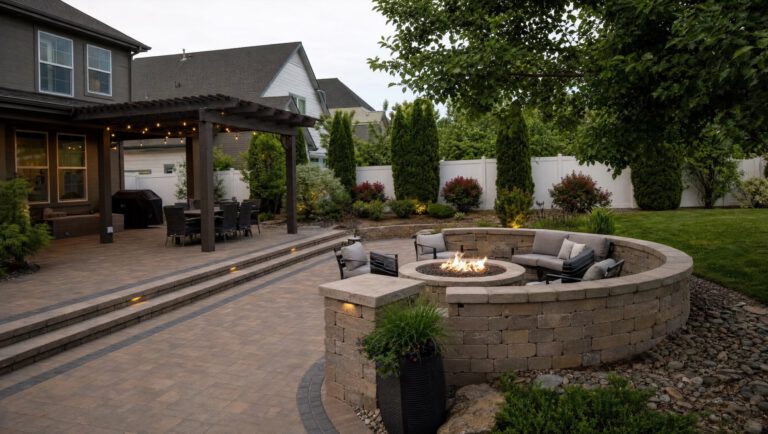
The single biggest shift in how premium outdoor spaces are being designed is the move from a single undifferentiated patio to a collection of distinct, purpose-built zones — each with its own character, function, and hardscape treatment.
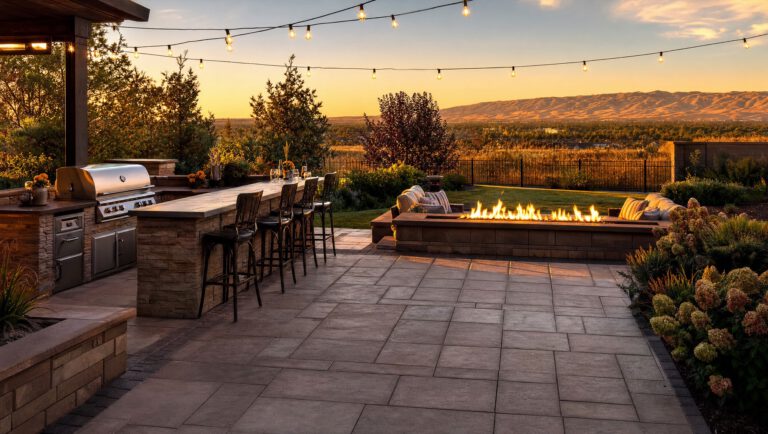
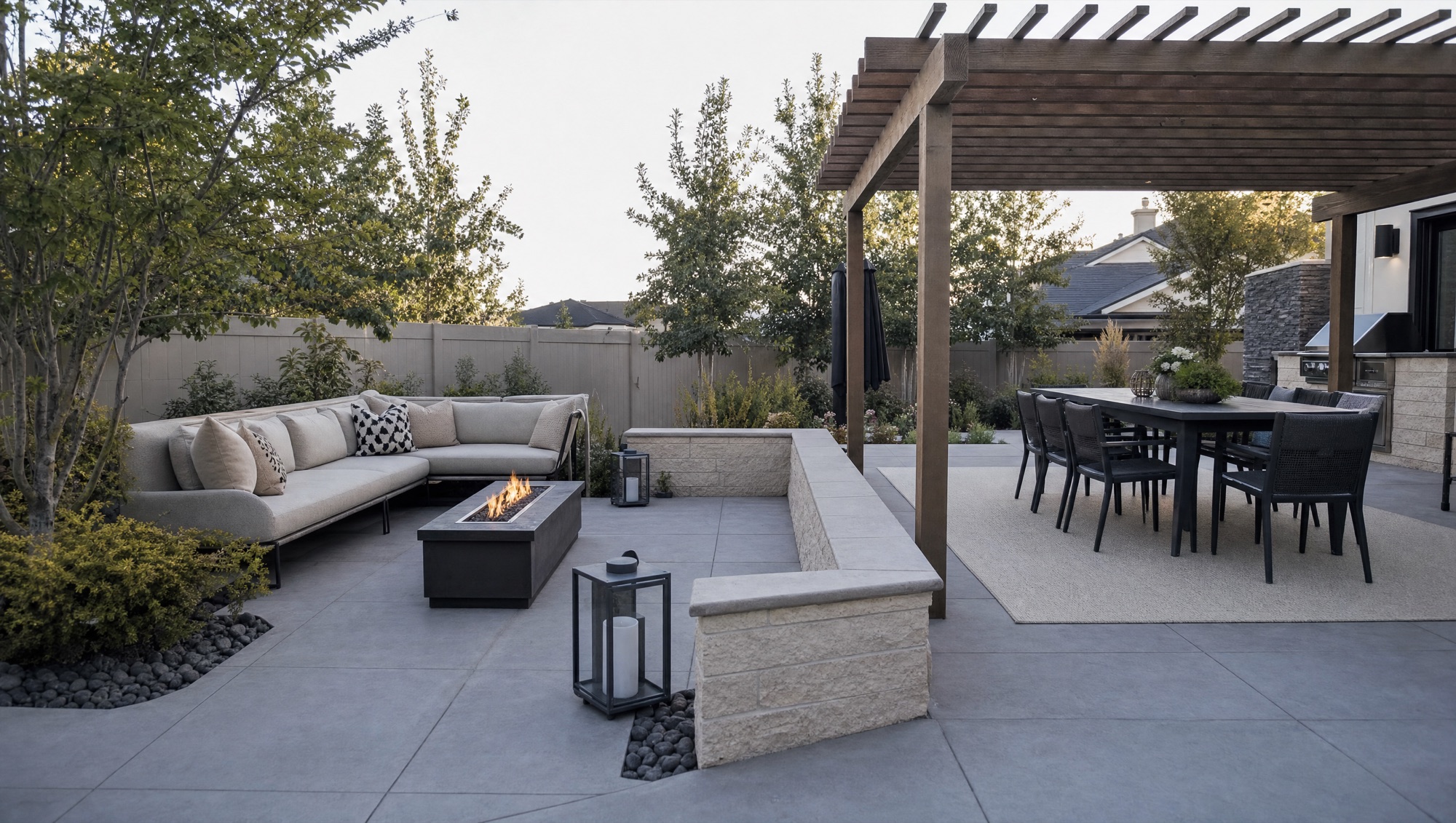
Where a project from ten years ago might have been a 400 square foot rectangular concrete patio off the back door, a comparable project today is more likely to include a dining zone adjacent to the kitchen, a lounge zone with a fire feature further into the yard, a transition path between them, and possibly a third zone — a bar area, a hot tub pad, or a covered outdoor kitchen — each defined by changes in paver pattern, elevation, or material that create visual separation without physical barriers.
This approach works particularly well with pavers because the material allows seamless transitions between zones — a change in pattern, a border course, or a slight grade change communicates “this is a different space” without requiring walls, fencing, or landscaping to define the boundary. The result feels like a thoughtfully designed interior floor plan, executed outdoors.
In the Treasure Valley, where lots in newer subdivisions tend to be more modest in depth but wider in frontage, this zoned approach also helps homeowners make the most of the space they have — creating the feeling of a larger outdoor living environment by layering uses intelligently rather than maximizing square footage in a single direction.
The most impactful outdoor living projects we build today aren’t bigger — they’re better organized.
Trend 2: Warm, Natural Palettes Replacing Cool Gray
The cool gray palette that dominated hardscape design for much of the last decade is giving way to warmer, earthier tones — tans, tawny beiges, sandstone profiles, warm charcoals, and blended natural stone colorways that feel connected to the landscape rather than imposed on it.
In the Treasure Valley, this shift is particularly well-suited to the regional environment. The high desert palette of Idaho — the warm sage, the golden hillsides, the terracotta soil in parts of the valley — aligns naturally with these warmer paver tones in a way that cool grays never quite did. Projects built in warm earth tones tend to feel like they belong on the site; cool gray installations can feel like they were shipped in from somewhere else.
Large-format pavers in these warmer tones have become especially popular for pool surrounds and main patio areas, where the expansive surface benefits most from a material that feels warm underfoot and ages gracefully in Idaho’s intense summer sun. Colors that hold their depth over time — rather than fading toward a washed-out version of themselves — are a consistent priority for the high-end buyers we work with.
Borders and accent courses in contrasting tones are also trending — a darker border framing a warm field paver creates definition and a custom, designed quality that distinguishes the installation from a standard single-material pour.
Trend 3: Integrated Seating Walls as Design Architecture
Built-in seating walls have moved from an occasional feature to a near-standard component of premium patio designs in the Treasure Valley. They serve multiple functions simultaneously — defining the edge of a patio zone, providing casual seating for entertaining, creating visual structure, and adding vertical dimension to what would otherwise be a flat horizontal surface.
Structurally, a paver seating wall is an extension of the hardscape system — built on the same compacted base, using compatible or matching materials, and engineered to handle the load and movement that any outdoor structure faces in Idaho’s climate. Done well, a seating wall feels like it grew out of the patio rather than being placed on top of it.
The design flexibility is significant. Seating walls can be straight or curved, capped with a different material than the wall face for contrast, lit from beneath with integrated low-voltage lighting, or combined with planters, fire features, or water elements for added function. In Eagle and the foothills, where tiered outdoor spaces are common, seating walls often do double duty as retaining elements — holding grade while also defining the edge of an upper patio level.
From a project value standpoint, seating walls are among the most efficient investments in a patio project. They add function, visual interest, and design sophistication at a cost that’s proportionally modest relative to the impact they have on how the space feels and how many people it can comfortably accommodate.
Trend 4: Year-Round Usability as a Design Requirement
Treasure Valley homeowners are increasingly designing outdoor spaces not for peak summer use, but for use across as many months of the year as possible. This has meaningful implications for how projects are scoped and what features are included.
The practical elements that extend outdoor season in our climate:
- Fire features — gas fire pits and fire tables are now standard on most premium patio projects, extending comfortable outdoor use well into October and creating gathering focal points for shoulder-season evenings
- Covered structures — pergolas, shade sails, and full patio covers protect against both summer sun and shoulder-season rain, making the space usable in conditions that would otherwise push people indoors
- Outdoor heating — infrared heaters mounted to pergola structures or overhead covers add meaningful warmth for cool fall and early spring evenings
- Lighting — integrated low-voltage lighting in seating walls, steps, and path borders extends usability into evening hours across all seasons
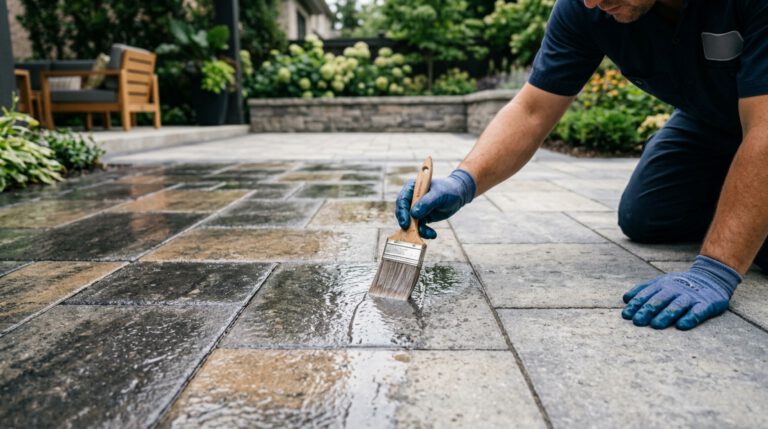
The hardscape implication of this trend is that surfaces need to be designed for year-round performance — not just summer aesthetics. Drainage that handles spring runoff, materials that manage freeze-thaw stress, and surfaces that remain safe and usable in wet conditions are design requirements, not optional considerations, when the goal is a space that gets used in March and November as well as July.
The best outdoor spaces in the Treasure Valley aren’t seasonal — they’re designed to earn use across as much of the year as Idaho allows.
Trend 5: Large-Format Pavers for Clean, Contemporary Surfaces
Large-format pavers — 24″ x 24″ and larger — have seen dramatic growth in popularity across the Treasure Valley over the past few years. The appeal is straightforward: fewer joints, cleaner lines, and a more expansive, contemporary surface that reads as a single cohesive plane rather than an assembly of smaller units.
Pool decks and main patio areas are where large-format pavers have had the most impact. Around a pool, where the surface is a dominant visual element viewed from above as well as across, the clean geometry of large-format pavers creates a resort-quality aesthetic that’s become the reference standard for high-end residential projects in the valley.
The installation demands of large-format pavers are worth understanding. Their size amplifies any imperfection in the bedding layer — a slight dip or high point that would be invisible with smaller pavers becomes noticeable in a large format. This means that base preparation and bedding sand screeding need to be executed to tighter tolerances than standard installations. The contractors who do this work well command a premium for a reason; the contractors who don’t produce a surface that looks worse with large-format pavers than it would have with smaller ones.
Porcelain large-format pavers are also gaining traction at the top of the market — offering ultra-low maintenance, consistent coloring, and an especially refined surface profile. They require specific installation expertise and compatible adhesive systems, and they represent a meaningful premium over concrete pavers, but for the right project they produce a result that’s difficult to match with any other material.
Trend 6: Driveway-to-Backyard Hardscape Continuity
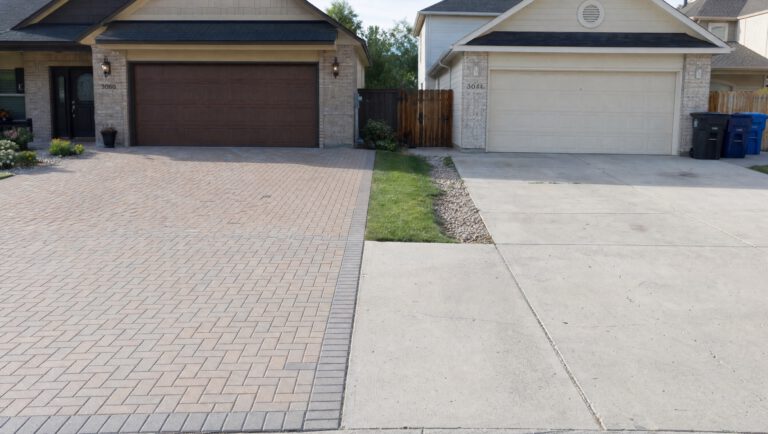
One of the more design-forward trends we’re executing across the valley is the intentional visual and material connection between front-of-home hardscape and backyard living spaces. Rather than treating the driveway, entry walkway, and backyard patio as separate projects with separate aesthetics, homeowners are commissioning unified hardscape designs that carry consistent materials, colors, and patterns from the street all the way through to the outdoor living space.
The effect is striking. A property where the driveway, front walkway, front entry feature, side yard path, and backyard patio all share a design language feels curated and intentional in a way that individual isolated installations never achieve. It signals that the property was thought through holistically — which has real implications for curb appeal, neighborhood presence, and resale value.
Practically, this trend is also efficient. A contractor already mobilized on a property for a driveway replacement is in the ideal position to extend that work to the walkways and entry — the incremental cost is materially lower than scheduling a separate mobilization later. Homeowners who think about their hardscape as a whole property investment, rather than a series of individual projects, typically get better outcomes at better total cost.
Trend 7: Permeable Pavers for Drainage-Challenged Sites
Permeable paver systems — which use wider joints filled with clean stone aggregate to allow water to pass through the surface and disperse into a specifically designed base — are gaining real traction in the Treasure Valley, particularly for driveways and areas with persistent drainage challenges.
The appeal in our market is practical as much as environmental. Lots in many of the valley’s newer subdivisions have soil profiles that don’t drain freely, irrigation systems that put consistent water into the ground throughout the growing season, and relatively flat grades that don’t naturally move surface water away from structures. A permeable driveway actively manages stormwater rather than shedding it all as runoff — reducing puddles, minimizing erosion, and easing the drainage burden on the surrounding landscape.
Some HOAs and municipalities in the Treasure Valley have begun encouraging or requiring permeable surface options for new construction and renovation projects as part of stormwater management goals. Homeowners who are planning driveway replacements in these areas are worth consulting with about permeable options early in the planning process, as the base specification and drainage design are meaningfully different from conventional installations.
The aesthetic quality of permeable paver systems has improved significantly. Earlier versions could look utilitarian; current product lines from major manufacturers offer permeable systems that are visually equivalent to conventional pavers and appropriate for high-end residential applications.
Trend 8: Retaining Walls as Landscape Architecture
In the sloped terrain that characterizes many of Eagle’s premium neighborhoods and the foothills communities above the valley floor, retaining walls have evolved from purely functional grade-holding structures into genuine design features — materials-forward, carefully detailed, and integrated with the broader outdoor living design in a way that makes them feel intentional rather than necessary.
The shift is visible in material choices. Block retaining walls in natural stone profiles, combined with cap materials that match or complement the patio pavers, have replaced the utilitarian concrete block walls that were standard a decade ago. Curved wall profiles that follow the natural contours of the site are replacing the straight-line approach that was the default when walls were purely functional.
Tiered wall systems — multiple levels of walls creating terraced outdoor spaces — are particularly well-suited to the foothills sites we work on most in Eagle and north Boise. A sloped backyard that might otherwise be unusable becomes, with a thoughtful tiered wall design, a series of distinct outdoor rooms at different elevations. The engineering demands of these systems are significant — drainage behind retaining walls, proper backfill, and structural integrity over the long term require specific expertise — but the design and livability outcomes justify the investment for properties where the terrain allows it.
Even on flatter valley lots, low-profile seat walls and planter walls are being used to create vertical dimension and define space in ways that paving alone can’t achieve. The trend is toward walls that do multiple things at once: hold grade, provide seating, frame planting, and contribute to the overall visual architecture of the outdoor space.
What Do These Trends Mean for Your Project?
Trends are useful context, but the right outdoor living design for your property is the one that fits how you live, how your lot is configured, what your home looks like, and what you want the space to do for you. The most beautifully executed large-format paver patio is wasted if the orientation is wrong for how you entertain. The most on-trend fire feature doesn’t add value if it’s placed where no one naturally gravitates.
What the trends above share is an underlying principle: outdoor spaces work best when they’re designed with intention — for real use, in a real climate, on a real site. The contractors and homeowners who produce the best results are the ones who start with function and let aesthetics follow, rather than the reverse.
Twenty years of building in the Treasure Valley has taught us that the projects homeowners are most proud of are almost never the ones that followed the trend most closely. They’re the ones that were designed specifically for their family, their lot, and their life — and then executed with the quality to make sure they hold up long enough to be worth being proud of.
Thinking About What to Build? Let’s Talk.
Whether you’re in the early inspiration phase or ready to move forward with a project, a conversation with our team is the fastest way to get from ideas to a clear picture of what’s possible on your specific property. We’ll walk your site, talk through what’s working and not working in your current outdoor space, and bring 20+ years of Treasure Valley project experience to the conversation.
Several of these are already showing up in our outdoor living builds in Meridian.
Book a Project Discovery Call today.
Prefer to talk it through now? Call (208) 609-9805 — no cost, no commitment, just a conversation.
Frequently Asked Questions
What outdoor living features add the most value to a home in Boise, Idaho?
In the Treasure Valley’s current market, the features that consistently generate the strongest return on investment are well-designed paver patios with integrated seating walls, fire features, and outdoor kitchens — particularly when they create a cohesive, multi-zone outdoor living environment. Paver driveways that tie into the backyard hardscape aesthetic also perform strongly at resale. Real estate professionals in the Boise area regularly cite outdoor living quality as a significant differentiating factor in both sale price and time on market.
What paver colors and styles are trending in Boise in 2026?
Warm earth tones — tans, sandstone profiles, tawny grays, and blended natural stone colorways — are dominant in current Treasure Valley projects, replacing the cool gray palette that prevailed for much of the last decade. Large-format pavers in these warm tones are especially popular for pool decks and main patio areas. Design-forward buyers are also gravitating toward border contrasts and mixed-material combinations that create a custom, curated feel.
How much does it cost to build an outdoor living space in the Treasure Valley?
Outdoor living spaces in the Treasure Valley range widely — from a straightforward paver patio in the $15,000 to $25,000 range for a modest scope, to comprehensive multi-zone outdoor living environments with integrated features that run $75,000 to $150,000 or more. The right investment depends on the size of the space, the materials selected, and what features are included. A site visit and detailed proposal is the only reliable way to understand what a specific project would cost.
What is the most popular outdoor patio feature in Boise right now?
Fire features — gas fire pits and fire tables — are currently among the most consistently requested elements on premium patio projects in the Treasure Valley. Their popularity reflects the year-round usability goal that drives most of our high-end work: a fire feature extends comfortable outdoor use well into fall, creates a natural gathering focal point, and adds warmth and ambiance that makes a patio feel finished rather than merely functional.
Are seating walls worth adding to a paver patio?
Seating walls are among the most cost-effective additions to a paver patio project on a value-per-dollar basis. They define space, provide flexible seating for entertaining, add vertical dimension to a flat surface, and can incorporate lighting, planters, and other features. Built on the same base system as the patio itself, they’re structurally integrated rather than added on — which means they don’t introduce new drainage or stability concerns. For most premium patios, a seating wall is a near-standard recommendation.
What is the difference between a patio and an outdoor living space?
A patio is a paved surface. An outdoor living space is a designed environment — a collection of purposeful zones, features, and elements that together create a place people actually want to spend time in. The distinction matters because it changes how you approach the design: a patio is sized and specified; an outdoor living space is planned around how people will move through it, what they’ll do in each zone, and what the space needs to feel like at different times of day and across different seasons.
Nostalgic Paver Systems · Boise, Idaho · Serving the Greater Treasure Valley · nostalgicpavers.com
Nostalgic Paver Systems
Planning a project of your own?
Let’s talk through your space, your timeline, and what it would take to build it right the first time.
Book a Project Discovery Call