Pavers vs. Concrete: An Honest Breakdown for Homeowners Planning a $50K+ Project
We install pavers for a living, so you’d expect us to tell you pavers are better. The reality is more useful than that. Here’s what both materials actually deliver — and where each one falls short — so you can make the right call for your project.
If you’re planning an outdoor project in the $50,000 to $150,000 range in the Treasure Valley, the pavers-versus-concrete question is going to come up. It might come up in your own research, from a contractor who offers both, or from a neighbor who has an opinion about what you should do. The answers you’ll find online range from genuinely helpful to completely misleading, and most of them are written by companies selling one or the other.
We sell pavers. We’ve built our business around them for over 20 years. But we’ve also been in this trade long enough to know that pavers aren’t the right answer for every project, every site, and every homeowner. Concrete has real advantages in certain applications, and pretending otherwise doesn’t serve anyone.
This piece is our honest attempt to lay out the comparison — material by material, category by category — so you can evaluate both options against the specific demands of your project, your property, and Idaho’s climate. Where pavers win, we’ll say so. Where concrete wins, we’ll say that too.
Durability and Lifespan
This is the category where both materials have legitimate claims, and where the details matter more than the headline numbers.
Poured concrete has a typical functional lifespan of 25 to 30 years in moderate climates. In Idaho, that number is lower — more realistically 15 to 25 years — because of freeze-thaw cycling. Concrete is rigid, and it responds to the expansion and contraction of freezing water and expansive clay soils by cracking. Control joints are designed to direct where cracking occurs, but they don’t prevent it. Over time, cracks propagate, surfaces spall, and the installation degrades in ways that affect both appearance and function.
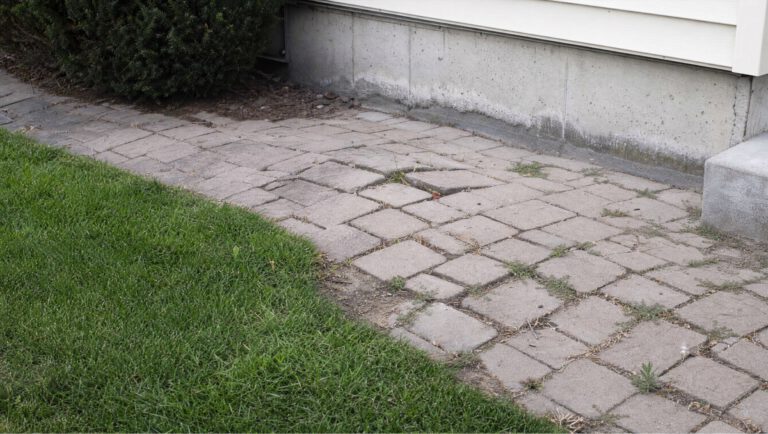
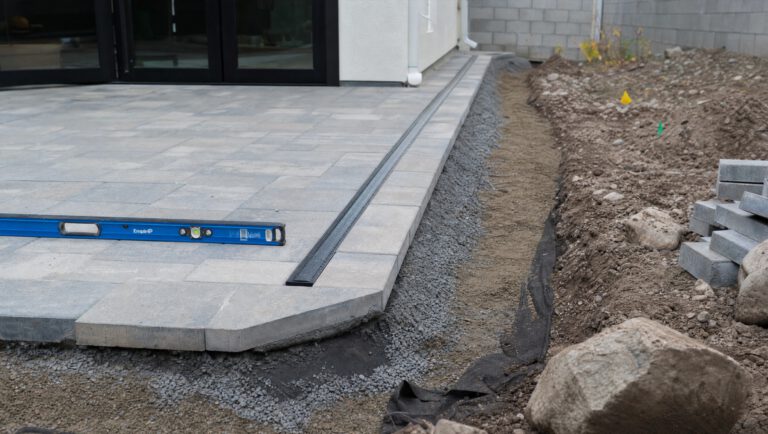
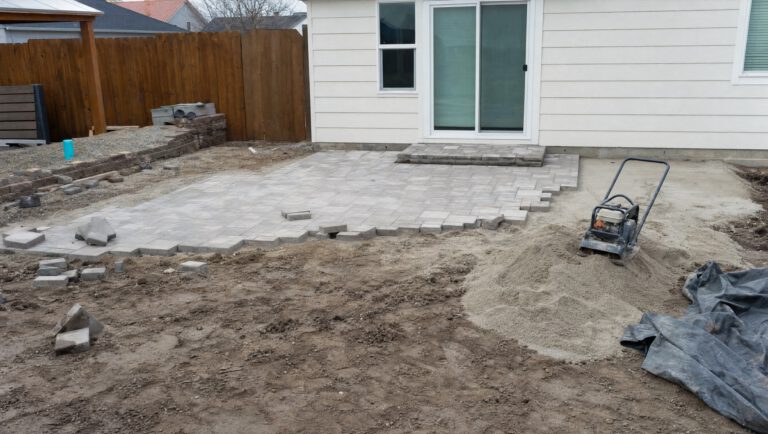
Pavers are individual units set on a flexible base system. Each paver is small enough to absorb minor ground movement without cracking, and the joint system between pavers allows the installation as a whole to flex with seasonal soil movement rather than resisting it. A properly installed paver system in Idaho — with adequate base depth, proper drainage, and quality joint sand — has a functional lifespan of 25 to 40 years, with the pavers themselves lasting essentially indefinitely. The lifespan limitation is the base and joint system, not the pavers.
The honest assessment: Pavers have a meaningful durability advantage in Idaho’s climate. The flexible system handles freeze-thaw cycling and soil movement better than a rigid concrete slab. That advantage is entirely dependent on proper installation — a poorly built paver system will fail faster than a well-built concrete slab.
Repair and Maintenance
This is where the difference between the two materials is most dramatic, and it’s the category that matters most for long-term cost of ownership.
Concrete repair is inherently compromised. When a concrete slab cracks, settles, or spalls, the repair options are limited and visible. Crack filling addresses the symptom, not the cause. Mudjacking or polyurethane injection can lift settled sections but doesn’t prevent future settlement. Surface resurfacing can improve appearance temporarily but typically fails within a few years because the new surface doesn’t bond well to the old. And if a section needs to be removed and replaced — because of a utility repair, a tree root, or structural failure — the new pour will never perfectly match the color and texture of the existing surface. The patch is permanent and visible.
Paver repair is fundamentally different because the system is modular. Individual pavers can be pulled up, the base beneath corrected, and the same pavers relaid — often with no visible evidence that the repair occurred. If a utility company needs to trench through your paver driveway, the pavers are pulled, the work is done, and the pavers go back. If a section settles due to a localized drainage issue, that section is lifted and the base is corrected without disturbing the rest of the installation.
The honest assessment: Pavers win this category decisively. The ability to repair invisibly and address subsurface issues without destroying the finished surface is a significant practical and financial advantage over the life of the installation. This is particularly relevant in Idaho, where freeze-thaw cycling and clay soil movement make some degree of long-term maintenance virtually inevitable.
Aesthetics and Design Flexibility
Both materials offer a wide range of aesthetic options, but they achieve them differently and with different long-term trajectories.
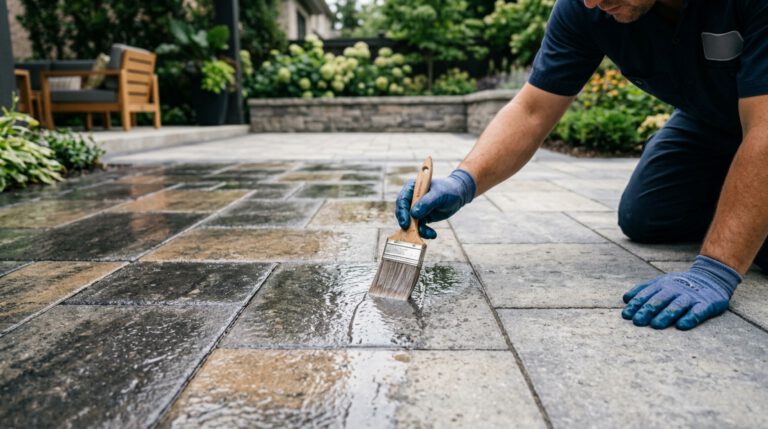
Concrete offers extensive decorative options at installation: stamped patterns, exposed aggregate finishes, integral color, acid staining, and various surface textures. The range of achievable looks is broad, and a skilled concrete finisher can produce beautiful results. The limitation is time. Decorative concrete surfaces degrade with wear, UV exposure, and freeze-thaw cycling. Stamped patterns lose definition. Colors fade. Sealers wear off and require reapplication every two to three years. The surface you see at year one is the best it will ever look.
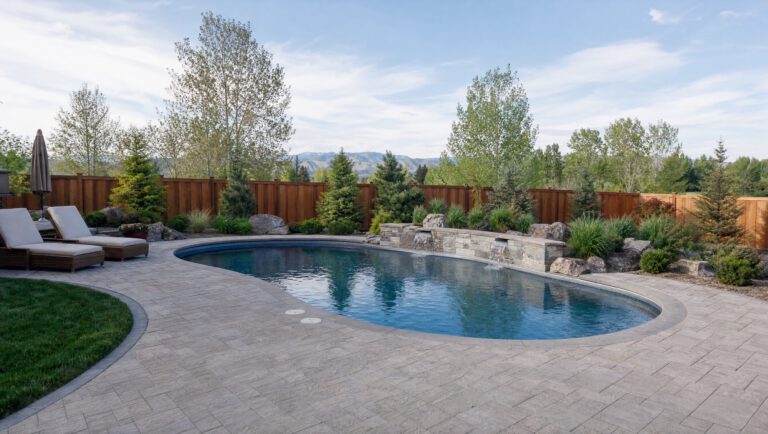
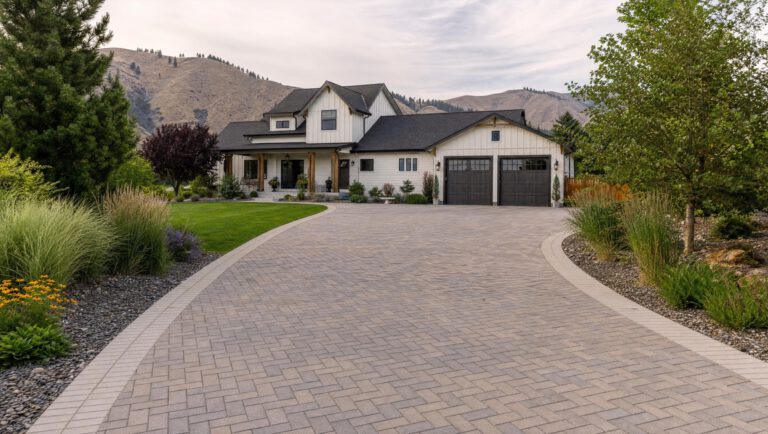
Pavers offer a different kind of design flexibility — one based on the product itself rather than applied treatments. The color, texture, and pattern are inherent to the material, not applied to the surface. They don’t fade meaningfully over time, and they don’t require sealing to maintain appearance (though some homeowners choose to seal for color enhancement). The design vocabulary is different: instead of stamped imitations of stone or brick, you’re working with actual manufactured or natural stone units in a virtually unlimited range of patterns, colors, and textures.
The honest assessment: This category is closer to a tie than most paver companies will admit. Fresh decorative concrete can be stunning, and it achieves certain monolithic, contemporary looks that pavers can’t replicate. Pavers offer superior long-term aesthetic durability — the surface at year 15 will be closer to the surface at year one than any decorative concrete treatment can maintain. For premium projects where long-term appearance matters, pavers have the edge. For projects where a specific contemporary aesthetic is the priority and the homeowner is comfortable with periodic maintenance, concrete can be the right choice.
Cost: Upfront and Long-Term
Cost is the category where the most misleading comparisons are made, because the two materials have fundamentally different cost profiles over time.
Upfront cost: Poured concrete is less expensive to install per square foot than pavers in nearly every application. For a basic gray broom-finished concrete slab, installed costs in the Treasure Valley typically run $12 to $18 per square foot. Decorative stamped concrete runs $18 to $28 per square foot. Paver installations, properly built with adequate base depth for Idaho conditions, typically run $28 to $55 per square foot depending on the paver product and the complexity of the installation. For a 1,500-square-foot driveway, the difference between stamped concrete and a quality paver installation can be $15,000 to $40,000.
Long-term cost: This is where the comparison shifts. Concrete requires resealing every two to three years ($1.50 to $3.00 per square foot per application), eventual crack repair, and — for most Idaho installations — partial or full replacement within 15 to 25 years. A properly built paver installation requires joint sand refreshment every 8 to 12 years (roughly $1,500 to $3,000 for a typical patio), occasional spot repairs, and essentially no planned replacement within a normal homeownership period.
Over a 25-year ownership horizon, the total cost of ownership for pavers and premium decorative concrete tends to converge — and in many cases, pavers come out ahead because they avoid the major replacement cost that concrete eventually requires.
The honest assessment: Concrete costs less upfront. Pavers cost less over time. For homeowners planning a $50,000 or greater project with a long-term ownership horizon, the total cost-of-ownership analysis typically favors pavers — but the upfront premium is real and matters for budgeting.
Idaho Climate Performance
This is the tiebreaker category for most Treasure Valley homeowners, and it’s the one where the comparison is least ambiguous.
Idaho’s climate imposes three specific demands on hardscape materials: freeze-thaw resistance, tolerance for expansive clay soil movement, and resistance to the temperature extremes that range from -10 degrees in January to 105 degrees in July.
Concrete is rigid. It responds to soil movement and thermal expansion by cracking. Control joints manage where cracks form, but they don’t prevent the cracking itself. After 10 to 15 years of Idaho freeze-thaw cycling, most concrete installations show visible deterioration — surface spalling, crack propagation beyond control joints, and joint failure.
Pavers are flexible. The individual units and the joint system accommodate ground movement, and the base system — when properly specified for Idaho soils — provides the drainage and structural support needed to handle freeze-thaw cycling without progressive damage. The failure modes that affect pavers in Idaho are real, but they’re repairable and preventable with proper specification.
The honest assessment: For Idaho’s climate, pavers are the superior material. The flexible system handles the specific demands of Treasure Valley conditions — freeze-thaw cycling, expansive clay, and extreme temperature range — better than rigid concrete. This advantage is not theoretical; it’s visible in the relative condition of paver and concrete installations across the valley after 10 or more years of service.
Ready to Get It Done Right?
We’ve tried to give you an honest comparison. Pavers aren’t perfect, and concrete isn’t bad. But for premium outdoor projects in the Treasure Valley — projects where long-term performance, repairability, and aesthetic durability matter — pavers deliver outcomes that concrete can’t match in this climate.
If you’re weighing the two options for a major project, we’re happy to walk your site, review your goals, and give you a straight answer about which approach makes the most sense for your specific situation. No pressure, no pitch — just an honest conversation about what will work best.
If you are leaning toward pavers, here is what our Boise paver installation work actually involves.
Book a Project Discovery Call today.
Prefer to talk it through now? Call (208) 609-9805 — no cost, no commitment, just a conversation.
Frequently Asked Questions
Are pavers more expensive than concrete in Boise?
Yes, upfront. Paver installations properly built for Idaho conditions typically cost $28 to $55 per square foot, compared to $12 to $28 per square foot for concrete depending on the finish. Over a 25-year ownership period, the total cost of ownership tends to converge or favor pavers because of lower maintenance costs and the avoidance of the full replacement that concrete typically requires within that timeframe.
How long does poured concrete last in Idaho?
In the Treasure Valley’s freeze-thaw climate, poured concrete typically lasts 15 to 25 years before requiring significant repair or replacement. Decorative concrete treatments — stamped patterns, stained surfaces — often show wear earlier, with surface deterioration visible within 8 to 12 years. These numbers vary with installation quality, site drainage, and maintenance practices.
Can stamped concrete look as good as pavers?
When first installed, stamped concrete can look impressive and can achieve certain monolithic design effects that pavers cannot. The difference shows over time. Stamped concrete patterns lose definition with wear and freeze-thaw cycling, colors fade with UV exposure, and sealers require regular reapplication. Paver surfaces maintain their appearance with minimal maintenance because the color, texture, and pattern are integral to the material rather than applied to the surface.
Which is better for a driveway in Boise — pavers or concrete?
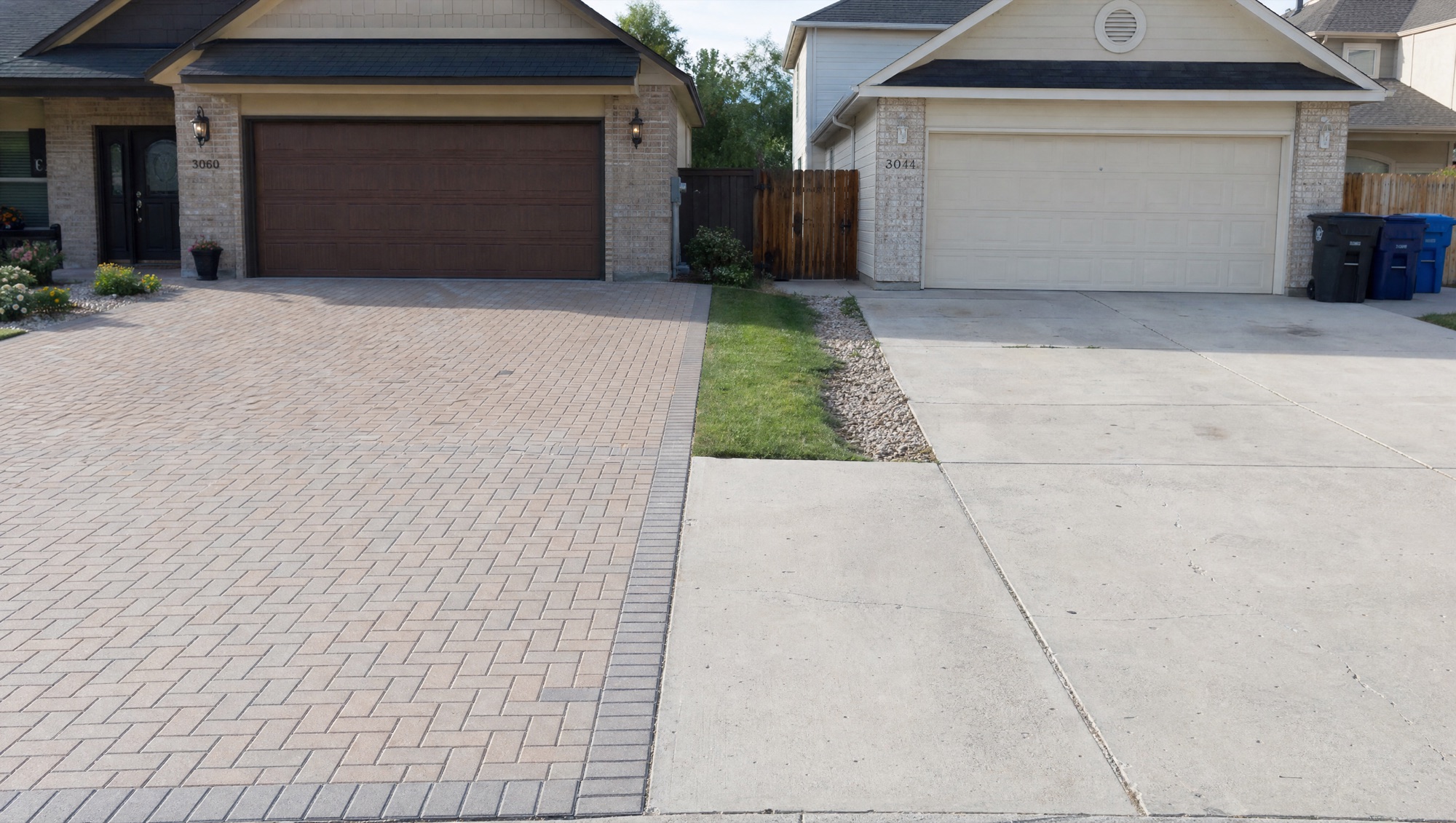
For driveways in the Treasure Valley, pavers offer significant advantages: they handle the freeze-thaw cycling and clay soil movement better, they can be repaired invisibly if a utility needs to trench through them, and they maintain their appearance longer. Concrete driveways are less expensive upfront but more susceptible to cracking and settling in Idaho’s climate, and repairs are always visible. For a premium project with a long-term ownership perspective, pavers are typically the stronger choice.
Do concrete patios crack in Idaho winters?
Yes. Cracking in poured concrete is expected in Idaho’s freeze-thaw climate, which is why control joints are part of every concrete installation — they direct where the cracking occurs. Over time, cracks typically propagate beyond the control joints, and surface spalling from freeze-thaw damage becomes visible. The rate and severity depend on installation quality, base preparation, drainage, and the number of freeze-thaw cycles the installation experiences each winter.
What’s the ROI difference between pavers and concrete for home resale?
Both materials add value when well-maintained. National data consistently shows that premium outdoor living improvements — which in the Treasure Valley typically means paver installations — rank among the highest-ROI exterior upgrades. The durability and aesthetic longevity of pavers tend to preserve more resale value than concrete over time, particularly in premium neighborhoods where buyers expect a certain level of finish. A paver installation that looks as good at resale as it did at installation is a stronger selling point than a concrete surface showing age-related wear.
Nostalgic Paver Systems · Boise, Idaho · Serving the Greater Treasure Valley · nostalgicpavers.com
Nostalgic Paver Systems
Planning a project of your own?
Let’s talk through your space, your timeline, and what it would take to build it right the first time.
Book a Project Discovery Call